


Historical documentation. This page describes the earlier English source. Its disease theories, device effects and recovery claims are not adopted as current medical or veterinary facts. It provides no treatment plan, dose or instruction to replace professional care.
A device within Clark’s research history
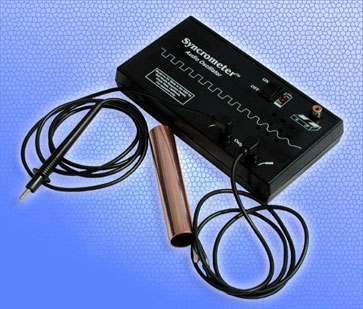
The earlier article connects Clark’s interest in radio with her description of organisms transmitting characteristic frequencies. It presents the Syncrometer as an audio oscillator circuit that compares resonance with a sample on a capacitor plate. This is a description of the source’s model, not an independently verified account of how substances or diseases can be detected.
The original distinguishes finding or testing from therapy. It says the Syncrometer was used in the research described in Clark’s books and separately identifies the Zapper with a different role. The two names should not be treated as interchangeable.
Claims made in the source
The previous text claimed detection of parasites, bacteria, viruses, fungi and toxins and described results as positive or negative rather than quantitative. It also claimed greater accuracy than established methods and gave an error estimate. Those statements are historical claims; this page does not validate their accuracy or turn repetition into a diagnostic guarantee.
A list of substances or organisms mentioned in a device description is not evidence that the device measures them. Likewise, a resonance comparison is not presented here as a laboratory concentration measurement.
Limitations already stated by the original
The source itself said that a Syncrometer test does not equal a medical diagnosis and that its measurements have no relation to conventional medical measurements. It distinguished its biofeedback research from accepted scientific testing and said quantitative information belongs to an approved, legally recognized laboratory.
These qualifications remain central. This page does not provide a diagnostic service, a test result or an interpretation of a reader’s symptoms.
Samples, practitioners and historical illustrations
The earlier text described practice by frequent users and postal saliva samples, including samples from pets and household products. That description is retained as historical context, not a new invitation to submit personal samples or a recommendation of remote testing. The original device illustrations remain below as documentation. Read the Zapper overview for the separate device history and the biography for the wider publishing context.
Historical illustrations
Related historical reading
ZAPPER BASICS · All you need to know regarding the Zapper · Who was Dr. Clark