


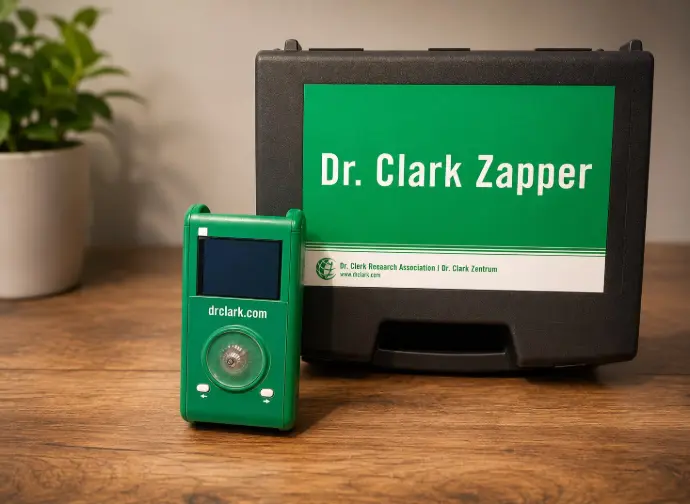
Historical source description. These details document Clark’s historical approach. They are not current medical intake or treatment advice, or evidence of efficacy or safety. The current device requires its matching manufacturer’s instructions.
At a glance
- Identify the model and matching documentation.
- Identify the power supply and intended accessories.
- Understand technical program terms.
- Check operation, stopping and care against the original manual.
The main Zapper page explains history and device concepts. For historical programs and the card list, see the program page.
Distinguishing four types of information
| Category | Examples from the collection | Treatment on this page |
|---|---|---|
| A: questions common to models | Distinguish model, manual, signal, accessories and program | Retained as preparation |
| B: historical models | Separate battery, power button, timer, handles and damp wristbands | Described as historical variants |
| C: device currently offered | USB-C, display, rotary control and integrated programs | Identified as current provider information |
| D: operation not yet verified | Connection sequence, contact position, menus, runtimes and cleaning | Check against the original manual |
“Common to models” means asking the same questions about different devices, not that accessories or operating steps are freely interchangeable.
Preparation: gathering documentation
Model and version
Record the exact device name and manual version. The current product description mentions firmware, but does not establish the version installed on an existing device.
Accessories
Historical sources mention hand electrodes, handles, wristbands and other contacts. The current description has its own supplied accessories. Connections depend on components intended for the actual model.
The right type of information
A technical drawing explains a signal; a program name identifies a menu or catalogue entry; a historical testimonial records an account. Separating these levels helps answer specific operating questions.
Historical descriptions of contacts
The site mentions contacts through hands, wrists, ankles or feet, along with materials, moisture and skin irritation. These remain descriptions of older variants.
No new positions or material advice for the green device is derived from these. Claims of superior conductivity or no irritation must match the actual accessories.
Signal, frequency and the historical 30 kHz question
The old text explains square-wave voltage, positive offset and about 30 kHz, linking them to its theory of current distribution in the body. This is technical and historical context; medical conclusions require separate assessment.
The historical oscilloscope image is neither a measurement report for the current device nor instructions to modify it. The program page explains the terms further.
Historical obstacles and insulator theory
The old page explains supposed current limits with an insulator theory linked to plate zapping. It remains a historical topic, not a current explanation of uncertain effects or symptoms.
Reading programs and schedules
Historical sources distinguish standard, continuous and frequency zapping: short stages with pauses, one uninterrupted session, and specific frequencies selected through external cards, among other methods.
These terms help read old sources. Historical schedules and calls to increase duration are not transferred to current menus. Disease-related card names are not a general operating sequence either.
Matching the original manual to the device
Historical source descriptions do not replace the manufacturer’s manual for the actual device.
These questions help identify the matching original manual; they are not a new operating sequence:
| Operating stage | Required original information |
|---|---|
| Preparation | Charging, power supply, device condition and intended preparation |
| Connection | Connections, matching accessories and allowed contacts |
| Selection | Menus, programs and indicators of this device version |
| Starting and stopping | Controls, interruption, automatic shutdown and runtimes |
| After use | Cleaning, care, storage and any wear parts |
Information must match the actual model. Another Zapper’s instructions, a Gamma manual or an old card description cannot substitute for this.
Suitability and unresolved safety questions
The old collection mentions pregnancy and pacemakers and blanket safety assurances based on low battery voltage. Those assurances are not current safety assessments. The current provider’s intended purpose excludes medical use.
Suitability, warnings and contraindications require the full manufacturer documentation for the actual device. Historical long-term use, child use and disease-related methods remain separate.
Preparing a specific operating question
Record model, manual version, accessories and menu entry, then specify the unclear step. This is easier to assess than a general request for “Zapper instructions”.
To the Zapper overview · Understand programs and frequencies · More guides
Frequently asked questions
Can I use old instructions for a new model?
General terms may help understanding, but connections, contacts, programs and runtimes must match the specific original manual.
What do old handle or wristband descriptions mean?
They document different accessory and contact variants. The matching manufacturer documentation determines which apply to the current device.
Is there an instructional video?
The old collection links to a video. Its model, content and currency need checking before embedding; an old link alone does not establish current operating steps.
Do I need additional program cards?
The current provider device is described as having integrated programs. For older devices this must be checked separately by model.
Technical figures from historical descriptions
These figures come from the old article. They are neither target values nor setting instructions for the current green device.
| Historical figure | Context in the old text | Interpretation |
|---|---|---|
| 5 to 10 volts | Low voltage of the former battery-powered concept | Voltage alone does not establish safety |
| 0.25 volts | Mentioned as the lower limit in a historical oscilloscope image | Not a current measurement report |
| About 30 kHz or 30,000 cycles per second, at about 5 volts | Historical explanation of frequency choice and uneven current distribution | Historical explanation, not instructions for all devices |
| 10 Hz to 500,000 Hz | Old comparison of regular and frequency zapping | Not a verified frequency range for every current model |
| 9-volt battery | Basis of the old blanket claim of no side effects | The resulting safety guarantee is not adopted |
The source names blood, lymph, arteries, veins, nerves and inflamed areas as supposed current paths. It calls eyes, appendix, testicles, ear ossicles, bowel contents, gallstones and living cells hard to reach. These belong to its historical theory, not proof of current medical device functions.
Historical schedules and frequency of use
| Name in the old collection | Period described there | Meaning when reading sources |
|---|---|---|
| Regular standard program | Three seven-minute stages with 20–30-minute breaks | Explained by the text’s theory of successively released pathogen stages |
| Additional sessions | The old text mentions fourth and fifth sessions | Part of the same historical theory, not new operating advice |
| Continuous program | One hour uninterrupted | Distinct from later claims of long-term use |
| Frequency and prolonged use | Daily routine, eight hours and all-day use over weeks or a month are mentioned | Not runtime or frequency instructions for a current device |
Claims of pathogen elimination within three, five or seven minutes and white-cell activation are attributed to Clark, not current disease recommendations. The programs and frequencies page explores the source context in more detail.
Plate zapping and historical insulator theory
The collection links PCBs, benzene, motor oil and wheel-bearing grease with supposed electrical organ insulation. Plate zapping is described as an organ-specific way around it. Claims about tissue, immune cells and pollutants are part of that theory.
A former two-cell layout section describes combinations involving arteries, veins and white cells, twenty-minute stages and use for eight hours or more, alongside enzyme powder. These passages are summarised historically, not published as actionable cancer or HIV instructions.
Old links remain identifiable as historical source traces: Plate zapping for cancer — old text [DE] and Plate zapping for HIV — old text [DE]. Linking does not endorse the medical effects claimed there.
Sources and technical further reading
The old article cites “Die Vorbeugung aller Krebsarten”, pages 475–478 and 83, and “Syncrometer Science Laboratory Manual”, pages 139, 140 and 81. Its notes about pregnancy, pacemakers and children are not a complete current safety assessment.
The old text also links to YouTube video c-s3bDm7Aws. It is not embedded as a verified current-model tutorial. Historical claims about symptom absence, pain, blood pressure, alertness or temperature do not replace manufacturer documentation.
Books and sources · Copyright notice [DE] · Historical Syncrometer basics · Start here