


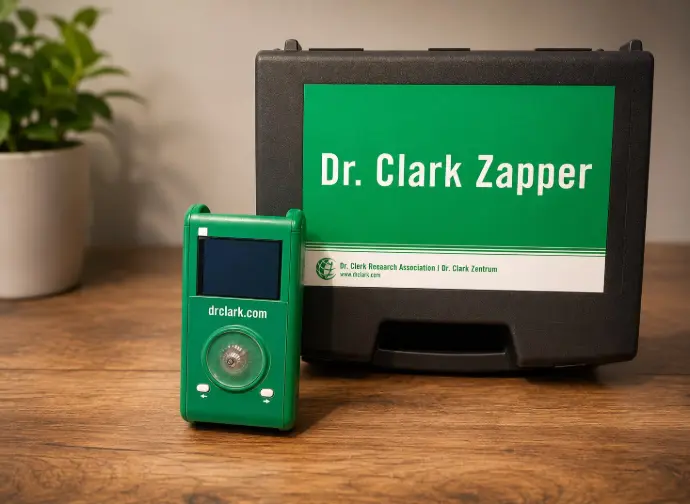
Historical source description. These details document Clark’s historical approach. They are not current medical intake or treatment advice, or evidence of efficacy or safety. The current device requires its matching manufacturer’s instructions.
At a glance
| Area | What you will find here |
|---|---|
| Historical Clark concept | Regular zapping and individual frequency selection |
| Historical programs | Standard, continuous and external cards |
| Technical terms | Frequency, square-wave signal and positive offset |
| Current device | Distinguishing integrated programs from older cards |
| Unresolved matching | No unchecked matching of card numbers, menu entries and diseases |
Regular zapping: standard and continuous
Clark described regular zapping with a positively offset square wave. Sources call it “frequency-independent”: frequency is not selected separately for each supposed pathogen.
The older standard description gives three seven-minute stages with roughly twenty-minute breaks. Elsewhere breaks are twenty to thirty minutes or extra sessions are added. These are source differences. “Continuous” initially means one uninterrupted hour; later passages extend this considerably.
The rationale involving successive pathogen stages and activated immune cells is Clark’s theory. Times are retained as historical descriptions, not current device runtimes.
What frequency describes
Frequency states how many times a recurring process repeats per second, measured in hertz. 30 kHz means 30,000 repetitions per second.
A square wave describes signal shape over time; positive offset describes its position relative to a reference. Shape, position and repetition rate are distinct and should not be confused.
Matching organisms to particular frequencies is a historical claim of Clark’s theory. A number in hertz alone does not answer that medical question.
Frequency zapping and the driver concept
The collection describes frequency zapping as selecting particular frequencies, first with a generator and later with programmed VariZapper or VariGamma cards.
According to the website, information on organisms and conditions from Clark’s books became program groups: initially 35, later 63 cards. This history explains the catalogue and its disease-related names.
The old text proposes rotations and combinations. Their names are not current disease-selection advice. Card number, exact wording and device generation remain essential for historical interpretation.
Historical card list: VariZapper/VariGamma
The table preserves all five language columns, numbers and original names. These are historical catalogue labels, not confirmed medical indications. Disease names are reproduced solely as historical entries.
| English | Deutsch | Français | Italiano | Español | |
|---|---|---|---|---|---|
| Z701 | Allergies | Allergies | Allergies | Allergie | Alergias |
| Z702 | Asthma | Asthma | Asthme | Asma | Asma |
| Z703 | High Blood Pressure | Bluthochdruck | Hypertension | Ipertensione | Hipertensión |
| Z704 | Chronic Fatigue | Chronische Müdigkeit | Fatigue chronique | Stanchezza cronica | Fatiga Crónica |
| Z705 | Diabetes | Zuckerkrankheit | Diabète | Diabete | Diabetes |
| Z706 | Neurological Balance | Neurologisches Gleichgewicht | Équilibre neurologique | Equilibrio neurologico | Equilibrio neurológico |
| Z707 | Fibromyalgia | Fibromyalgie | Fibromyalgie | Fibromialgia | Fibromiálgia |
| Z708 | Advanced Cancer | Fortgeschrittene Krebserkrankungen | Cancer avancé | Cancro avanzato | Cáncer avanzado |
| Z709 | Grippe | Flu | Grippe | Influenza | Influenza |
| Z710 | Skin problems | Hautprobleme | Peau | Problemi pelle | Problemas de la piel |
| Z711 | Herpes | Herpes | Herpès | Herpes | Herpes |
| Z712 | Heart | Herz | Cœur | Cuore | Corazón |
| Z713 | AIDS | HIV | VIH/SIDA | HIV | VIH/SIDA |
| Z714 | Headaches and Migraines | Kopfschmerzen und Migräne | Migraines et maux de tête | Mal di testa e emicrania | Cefaleas y migrañas |
| Z715 | Cancer | Krebs | Cancer | Cancro | Cáncer |
| Z716 | Liver/Cholesterol | Leber/Cholesterine | Foie/Cholestérol | Fegato/colesterolo | Higado/Colesterol |
| Z717 | Multiple Sclerosis | Multiple Sklerose | Sclérose multiple | Sclerosi multipla | Esclerosis multiples |
| Z718 | Kidneys | Nieren | Reins | Reni | Riñones |
| Z719 | Prostate | Prostata | Prostate | Prostata | Prostata |
| Z720 | Tumors | Tumore | Tumeurs | Tumori | Tumores |
| Z721 | Common Bacteria | Wichtige Bakterien | Bactéries communes | Batteri comuni | Bacterias comunes |
| Z722 | Common Parasites | Wichtige Parasiten | Parasites communs | Parassiti comuni | Parásitos comunes |
| Z723 | Common Viruses | Wichtige Viren | Virus communs | Virus comuni | Virus comunes |
| Z724 | Alzheimer’s | Alzheimer | Maladie d’Alzheimer | Morbo d’Alzheimer | Mal de Alzheimer |
| Z725 | Arthritis | Arthritis | Arthrite | Artrite | Artritis |
| Z726 | Common Fungi | Wichtige Pilze | Champignons communs | Funghi comuni | Hongos comunes |
| Z727 | Depression | Depressionen | Dépression | Depressione | Depresión |
| Z728 | Colitis | Colitis | Colite | Colite | Colitis |
| Z729 | Helicobacter Pyloridis | Helicobacter Pylori | Hélicobactère du pylore | Helicobacter piloro | Helicobacter pylori |
| Z730 | Crohn’s Diseases | Morbus Crohn | Maladie de Crohn | Morbo di Crohn | Mal de Crohn |
| Z731 | Parkinson’s | Parkinson | Parkinson | Parkinson | Parkinson |
| Z732 | Sinusitis | Sinusitis | Sinusite | Sinusite | Sinusitis |
| Z733 | Super Wide Sweep | Super Wide Sweep | Super Wide Sweep | Super Wide Sweep | Super WIde Sweep |
| Z734 | Warts | Warzen | Verrues | Verucche | Verrugas |
| Z735 | Endometriosis | Endometriose | Endométriose | Endometriosi | Endometriosis |
| Z736 | Eyes/Macular Degeneration | Augen | Yeux | Occhi | Ojos |
| Z737 | Lyme Disease | Borreliose | Borréliose de Lyme | Borreliosi di Lyme | Mal de Lyme |
| Z738 | Pain | Schmerzen | Douleur | Dolore | Dolor |
| Z739 | Teeth Bacteria | Zähne | Dents | Denti | Dientes |
| Z740 | Cystitis | Blasenkatarrh | Cystite | Cistite | Cistitis |
| Z741 | Hormonal Imbalance | Hormonelles Ungleichgewicht | Problèmes d’hormones | Squilibri ormonali | Desequilibrios hormonales |
| Z742 | Infertility | Unfruchtbarkeit | Infertilité | Infertilità | Infertilidad |
| Z743 | Tinnitus | Tinnitus | Accouphènes | Acufene | Tinito |
| Z744 | Earache/Otitis/Meniere | Ohrenschmerzen | Mal d’oreilles | Mal d’orecchio | Dolor de oreja |
| Z745 | Stomach Ulcers | Magengeschwüre | Ulcère à l’estomac | Ulcera gastrica | Ulceras gástricas |
| Z746 | Cysts | Zysten | Kystes | Cisti | Quistes |
| Z747 | Ovarian Cysts | Eierstockzysten | Kystes aux ovaires | Cisti ovariche | Quistes ováricas |
| Z748 | Menopausal Dysfunction | Wechseljahrbeschwerden | Ménopause | Menopausa | Menopausia |
| Z749 | Sore Throat | Halsschmerzen | Mal de gorge | Mal di gola | Dolor de la garganta |
| Z750 | Bronchitis | Bronchitis | Bronchite | Bronchite | Bronquitis |
| Z751 | Meningitis | Meningitis | Méningite | Meningite | Meningitis |
| Z752 | Pneumonia | Lungenentzündung | Pneumonie | Polmonite | Neomonia |
| Z753 | Children’s Diseases | Kinderkrankheiten | Maladies infantiles | Malattie dei bambini | Enfermedades infantiles |
| Z754 | ALS | Lateralsklerose | Sclérose Latérale Amyotrophique | SLA (sclerosi laterale amiotrofica) | SLA |
| Z755 | STD | Sexuell übertragbare Krankheiten | Maladies sexuellement transmissibles (MST) | STD (malattie trasmesse sessualmente) | STD Enfermedades transmisibles sexualmente |
| Z756 | Enteric/Digestive Problems | Verdauungsprobleme | Problèmes digestifs | Problemi digestivi/enterici | Problemas digestivos/entéricos |
| Z757 | Tropical Diseases | Tropenkrankheiten | Maladies tropicales | Malattie tropicali | Enfermedades tropicales |
| Z758 | Onco Viruses | Onkoviren | Oncovirus | Oncovirus | Oncovirus |
| Z759 | Acne | Akne | Acné | Acne | Acne |
| Z760 | Pets | Haustiere | Animaux | Animali domestici | Animales domésticos |
| Z761 | Hepatitis B | Hepatitis B | Hépatite B | Epatite B | Hepatitis B |
| Z762 | Tapeworm | Bandwürmer | Ténias | Tenie | Tenias, etapas larvales |
| Z763 | Tropical Dysentery | Tropische Ruhr | Dysenterie tropicale | Dissenteria tropicale | Disenteria tropical |
| Z764 | Homeographic Copy | Homöographische Kopie | Copies Homéographiques | Copia omeografica | Copia omeografica |
| Z765 | Herpes | Herpes | Herpes | Herpes | Herpes |
| Z766 | COVID-19 | COVID-19 | COVID-19 | COVID-19 | COVID-19 |
Notable differences in the list
The prose mentions 63 cards, but the table has 66 numbers, Z701–Z766. “Herpes” appears twice. Z709 has apparently swapped language columns, and several German cells contain English. These differences are preserved rather than silently corrected.
Current integrated programs
The current provider description lists 66 integrated programs. Equal totals do not prove identity with the 66 old rows. A current program list, model identification and matching documentation are needed.
Generator or Gamma-module capabilities are not automatically functions of every Zapper. The main Zapper page puts the device’s development in context.
Historical special methods and unresolved claims
Plate zapping, very long use and historical disease combinations belong to historical further reading, as do explanations of gut flora, side effects and immune activation.
This list documents the old website catalogue. It proves neither medical indications nor correspondence with current programs. Unsupported frequency values are not added. The current provider’s stated purpose excludes medical use.
Frequently asked questions
Where can I find Zapper frequencies?
This is the historical list of card names. It gives no numerical frequency per card. Values are not calculated from names or added.
Are regular and frequency zapping the same?
Historical sources distinguish general signal use from selected frequencies. A standard program and a card are therefore not interchangeable terms.
Why do card names mention diseases?
Names come from the historical catalogue concept. They are documented as source labels, not evidence of treatment.
Can old cards be transferred directly to the current device?
The exact mapping to integrated programs is unresolved. Equal totals are insufficient.
To the Zapper overview · Preparing for operation · Books and sources · Historical further reading
Figures and variants in the previous article
| Historical term or value | What the existing text says | Distinction |
|---|---|---|
| Standard | 7 minutes / 20-minute break / 7 minutes / 20-minute break / 7 minutes | Other passages give 20–30-minute breaks |
| Fourth and fifth sessions | Additional stages in the historical pathogen-stage theory | Not additions to a current device program |
| Continuous | One uninterrupted hour | Extended in old texts to all-day and weeks-long use until claimed recovery |
| Regular signal | 100% positive offset, square wave; the collection mentions 5–10 volts, seven minutes and 10–500,000 Hz | Historical description, not verified current specifications or effects |
| Driver concept | Initially 35, later 63 cards in the prose | The preserved table actually contains 66 numbers |
Old texts link regular zapping to blood and lymph and frequency zapping to targeted internal effects. Claims about current paths, pathogen stages, prions and immune activation remain historical explanations, not current medical confirmation.
Origins, rotation and combinations of old cards
The old article says Clark’s books were searched for organisms and conditions, names matched to frequency lists, then supplemented with contemporary internet research and user experience. This documents catalogue origins, not clinical validation.
Historical rotation examples are “Advanced Cancer”, “Cancer”, “Tumor”, “Onco Viruses”, and for tropical travel “Tropical Diseases” and “Tropical Dysentery”. Regular zapping after a card is also described. These are not current disease or travel recommendations. No verified numerical frequencies per card are supplied.
Historical questions on gut flora and side effects
The old FAQ cites “The Cure of all Diseases” on good and bad gut bacteria. Clark claimed partial sterilisation of bowel contents and later improved bowel function. This is not presented as an established effect.
For side effects, the collection cites “The Prevention of all Cancers” and claims about blood pressure, alertness, temperature and pain. Other passages claim white-cell activation despite “immune blockers”. This proves neither safety nor a current treatment recommendation.
The old purchase recommendation for a fully positively offset square wave also rests on a historical theory: Clark said negative signal portions supported pathogens. This is not adopted as a current product feature or promise of efficacy.
Historical sources
The old article names “The Cure for all Advanced Cancers”, “Syncrometer Science Laboratory Manual”, “The Cure of all Diseases” and “The Prevention of all Cancers”. Different title spellings remain recognisable source references. Book, language and edition must match each cited passage.
books overview · Understand the Clark Zapper · Understanding Zapper use · Start here