


At a glance
- The historical collection traces the development from a frequency generator to a portable battery-powered Zapper.
- Key terms are square-wave signal, frequency and positive offset.
- Zapper and Syncrometer have different roles in Clark’s concept.
- Older devices with batteries and program cards must be distinguished from today’s model.
- For specific operating steps, the application page provides the next step; terms and lists are explained in the program overview.
How the Zapper concept began
The Information Center says Clark initially selected individual frequencies in sequence on a frequency generator. In that account, her son built a portable battery-powered generator in 1994. The term “Zapper” developed from her observations at that time.
Clark linked the device to the idea of influencing pathogens electrically. A broad effect without individual adjustment for each pathogen became central to her regular zapping. This explains the approach and its terms; it is distinct from a current technical product description.
The basic technical principle
A repeating electrical signal
The older descriptions refer to a square-wave signal repeatedly switching between levels. Frequency means repetitions per second. The often-mentioned 30 kHz corresponds to 30,000 repetitions per second.
What positive offset means
This term concerns the signal’s position relative to an electrical reference line. Historical texts require a fully positive signal and show an oscilloscope illustration.
Measuring a signal and interpreting it medically are separate questions. Claims about pathogens, immune cells and negative signal components are presented as Clark’s theory, not as properties of a verified current product.
Why “frequency-independent” still has a frequency
In Clark’s terminology, this means regular zapping does not select a separate frequency for each suspected pathogen. The electrical signal still has a measurable frequency. Its difference from targeted frequency zapping is explained on the program page.
From the historical device to today’s model
The collection describes separate batteries, timers, electrodes and later additional program cards. It also mentions DIY instructions in Clark’s books. These document device history; a present-day description must follow the model and manufacturer’s documents.
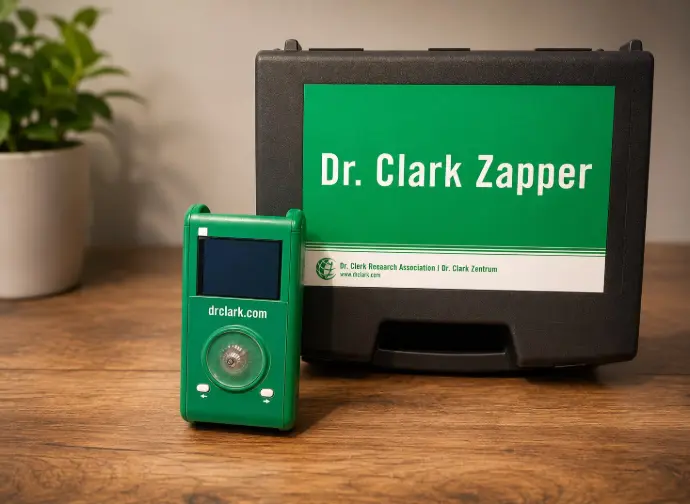
The current product information in the Swiss shop (CHF) lists a colour display, rotary control, USB-C charging and built-in programs. An older separate program-card list therefore cannot be read directly as today’s menu structure.
| Feature | Supplier information |
|---|---|
| Frequency range | 1 Hz to 1,000,000 Hz |
| Programs | 66 integrated frequency programs; no separate program cards required |
| Controls and power | Colour display, rotary control, rechargeable lithium battery and USB-C charging |
Source: current Dr. Clark Zapper product information in the Swiss shop (CHF), checked 1 November 2026. These are the supplier’s technical specifications, not an independent test or evidence of medical effectiveness. Check the exact model and its own manual; historical device figures are not substituted for current specifications.
The following comparison helps identify the differences:
| Historical description focus | Question for a current model |
|---|---|
| Replaceable battery and timer | What power supply and shut-off does its manual specify? |
| Handles, wristbands and different electrodes | Which accessories are intended for this model? |
| External program cards | Which programs are actually available in this device? |
| Oscilloscope image and DIY construction | Which technical documents belong to the original device? |
Zapper, frequency generator and Syncrometer
The frequency generator is the technical starting point in this history. The Zapper represents the application concept developed from it. The Syncrometer, in contrast, is described as part of Clark’s historical testing method.
These roles should remain separate in older articles too. Someone seeking Zapper operating information does not need Syncrometer instructions. Its history is covered in the Syncrometer basics.
Historical efficacy theory and current purpose
Clark’s texts link the device to broad claims about parasites, bacteria, viruses and immune cells, and describe combining it with herbal and cleansing programs. These claims document her method concept.
Today’s supplier expressly distinguishes the offered model from medical use. Equipment details, historical explanations and medical efficacy claims therefore remain distinct here. The earlier question of a “device against cancer” is not adopted as a product promise.
Continue to operation and programs
If you have a device in front of you, start with its model, manual and accessories. The application page organizes these steps. For standard, duration, frequency and driver-card terminology, use the program and frequency overview. Sources on Clark’s publications are collected in the books overview.
Frequently asked questions
What is a Clark Zapper?
An electrical device within her method concept. The historical collection describes a battery-powered signal with positive offset.
Is the Syncrometer the same device?
The collection assigns it a different role: it belongs to Clark’s test concept, whereas the Zapper generates electrical signals for the described application.
Do all old program cards belong to today’s device?
That equivalence is not established. Older cards and current built-in programs must be matched to their respective documents.
Where can I request the right manual, service or replacement accessories?
Use the supplier’s published contact details for model-specific enquiries. State your device model, the manual version if available, and the accessory or operating step in question. Ask the supplier to confirm compatibility and availability; an older card list or another device’s manual is not a substitute. The current product page identifies the included manual and accessories. This Information Center explains sources; orders, returns and product service are handled by the linked supplier.
Where can I put experience reports in context?
The historical collection leads to further sources. Personal experiences, editorial explanations and original sources must be assessed differently: these document types answer different questions.
Related topics and orientation
Explore historical technical reports
The earlier comparison of regular and frequency zapping explains the original terminology. The 1998 pilot report by Robert Thiel is presented as a historical source with its data and limitations.